
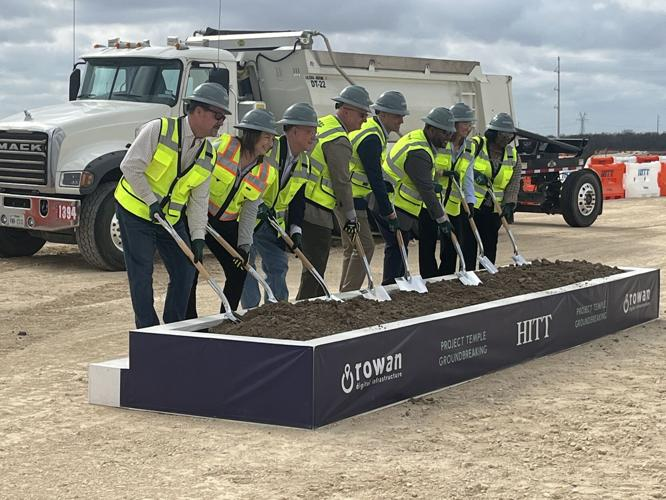
TEMPLE, TX — There is a particular brand of civic fever that takes hold when the modern world attempts to plant its flag in the soil of tradition. In Temple this week, that fever has manifested as a recall effort against three city leaders—a political guillotine brought out because the City Council had the audacity to plan for the city’s financial solvency in the 21st century.
At the heart of the storm are 700 acres along Bob White Road, recently annexed and rezoned to make way for a $700 million data center. To the protesters, this is an industrial invasion. To the record, it is a strategic necessity.
The Mirage of the “Water Vampire”
The loudest cry from the opposition concerns water—the lifeblood of Central Texas. The narrative suggests that this facility will drink the Leon River dry to cool its humming processors.
The Directory has reached out for specific cooling specifications, and while the final blueprints are often shielded by proprietary “trade secrets”—a bureaucracy I find personally offensive—the industry standard for new builds of this scale has shifted toward closed-loop or air-cooled systems precisely to avoid the environmental liability the protesters fear. Yet, in the absence of a loud, simple explanation from City Hall, the vacuum has been filled by the most frightening version of the story.
The Taxpayer’s Silent Benefactor
What the recall organizers fail to mention in their pamphlets is the “mechanical reality” of municipal budgeting. A data center is the ideal neighbor for a city’s finance director. It generates massive property tax revenue while demanding almost nothing in return. It requires no new schools, adds no significant traffic to the morning commute, and doesn’t call 911 because its neighbor’s dog is barking.
By opposing the Bob White Road project, the petitioners are essentially demanding that their own property taxes remain the primary fuel for the city’s engine. It is a classic case of wanting the sermon without the collection plate.
The Recall as a Failure of Discourse
A recall is a tool meant for the removal of the corrupt or the criminal. Using it to punish elected officials for a zoning vote—one aimed at long-term economic stability—is a perversion of the process. It suggests a citizenry that no longer wishes to debate policy, but rather to annihilate the policy-maker.
The “Mission to Civilize” requires us to acknowledge that a city cannot remain a museum of the 1950s while demanding 2026 services. Progress has a physical footprint. It has a sound. And occasionally, it requires 700 acres and a few miles of fiber optic cable.
Civic leadership is the art of making the unpopular choice today to ensure the city’s survival tomorrow. A recall petition is often just the sound of a population refusing to grow up.