
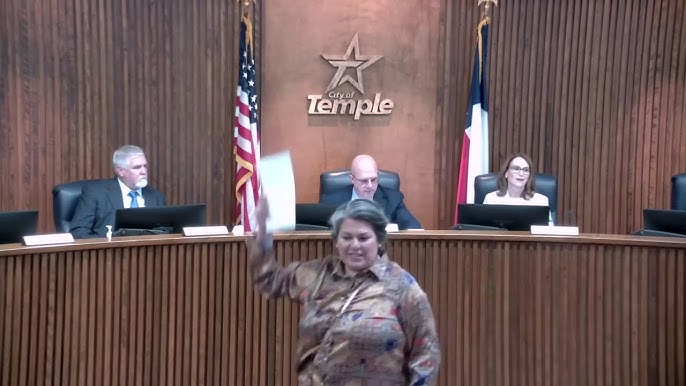
If you attended the recent city council meeting in Temple, you might have walked away thinking the apocalypse was breaking ground in Central Texas. Between the shouting and the outrage, residents lobbed accusations that incoming data centers would manipulate the weather, spawn tornadoes, and—in one particularly memorable recycling of an old internet meme—turn the local frog population gay.
It is easy to laugh, it’s also easy to understand the anxiety. When billion-dollar infrastructure suddenly arrives in your backyard, fear of the unknown is natural. But the loudest arguments dominating the microphone are completely detached from reality. If Texans are going to debate the merits of critical infrastructure, we need to stop fighting internet phantoms and start looking at the actual ledger.
Let’s start by clearing the air of the most outrageous claims. No, a data center cannot spawn a tornado. While these facilities vent significant heat, they do not possess the atmospheric thermodynamics required to create a supercell thunderstorm. Similarly, the recycled internet myths about data centers leaching agricultural pesticides into the water supply to “turn the frogs gay” are entirely baseless. These buildings house servers, not synthetic chemical plants.
So, why are these wild theories taking root in local town halls? The answer lies far beyond city limits. Cybersecurity experts and the U.S. State Department have repeatedly highlighted how foreign adversaries, specifically state-sponsored networks in China and Russia, use “hybrid warfare” to manipulate local U.S. politics. The U.S. and China are currently locked in a race for Artificial Intelligence supremacy, and data centers are the physical engines of that technology. By injecting targeted disinformation into local community groups, foreign actors stoke organic NIMBY (Not In My Back Yard) outrage. Delaying American infrastructure directly benefits foreign AI development.
The Resource Reality Check no one seems to trust. The most persistent, and seemingly logical, fear is resource depletion. Yet, when you look at the 15-year lifecycle of a modern data center, the math tells a different story.
It is widely believed that data centers will drain municipal water supplies. This was true a decade ago when facilities used open-loop evaporative cooling. Today, facilities like the ones proposed in Central Texas utilize closed-loop systems. Much like a car’s radiator, they require an initial fill (roughly equivalent to what forty average households use in a single year) and then continuously recirculate that same fluid for up to 15 years, requiring only minor top-offs.
Now, Power is a different story. A 300-megawatt facility draws as much electricity as hundreds of thousands of homes. However, the state is already ahead of the curve. Facing a massive waitlist, grid operators at ERCOT are increasingly mandating that tech companies “bring their own power.” To secure approval, data centers are now having to fund their own wind, solar, and natural gas infrastructure just to cover their massive footprint.
The most counter-intuitive reality of the data center debate is the economic impact. The common political criticism is: “They take up hundreds of acres but only bring 40 permanent jobs. What’s the point?”
From a municipal standpoint, that low job count isn’t a bug; it is the ultimate feature. When a traditional mega-factory or corporate headquarters moves into a county bringing 2,500 jobs, politicians cheer, but the municipal ledger groans. A massive influx of workers creates an immediate, heavy “service burden” on the city. It means hundreds of new children flooding the local independent school district, requiring new campuses that can cost taxpayers upwards of $100 million. It means thousands of daily commuters degrading local roads, increasing traffic, and a sudden population boom that forces the city to permanently expand its police, fire, and EMS budgets just to maintain baseline 911 response times.
Data centers, by contrast, are the ultimate “ghost taxpayers.” They represent a staggering capital investment, often pushing past the $1 billion mark, generating an astronomical amount of property tax revenue for the county and local school districts. But because they employ only a small, highly specialized team of 20 to 40 technicians, they demand almost nothing from municipal services in return.
They write massive checks to the local schools without adding a single student to a crowded classroom. They fund municipal maintenance without adding thousands of cars to the 5:00 PM commute. Because they don’t strain the system, nearly every tax dollar they pay acts as pure profit for the city’s budget. Instead of that revenue being immediately swallowed up to build new infrastructure to support new workers, it subsidizes the cost of living and improves existing services for the people who already live there.
There are legitimate, grounded conversations to be had about data centers. They are massive, windowless concrete boxes that alter the local landscape. Even with closed-loop systems, their external fan arrays and backup generators produce a low-frequency hum that requires strict local noise ordinances. If residents want to organize and push back, their energy is best spent demanding rigorous zoning, aesthetic mitigation, and strict noise limits before ground is ever broken.
But we have to stop tilting at windmills and fighting foreign-fueled internet conspiracies. Central Texas has an opportunity to host critical infrastructure that quietly bankrolls our communities without crowding our streets. It’s time we put away the science fiction, focus on the facts, and make sure the region cashes the check on our own terms.