
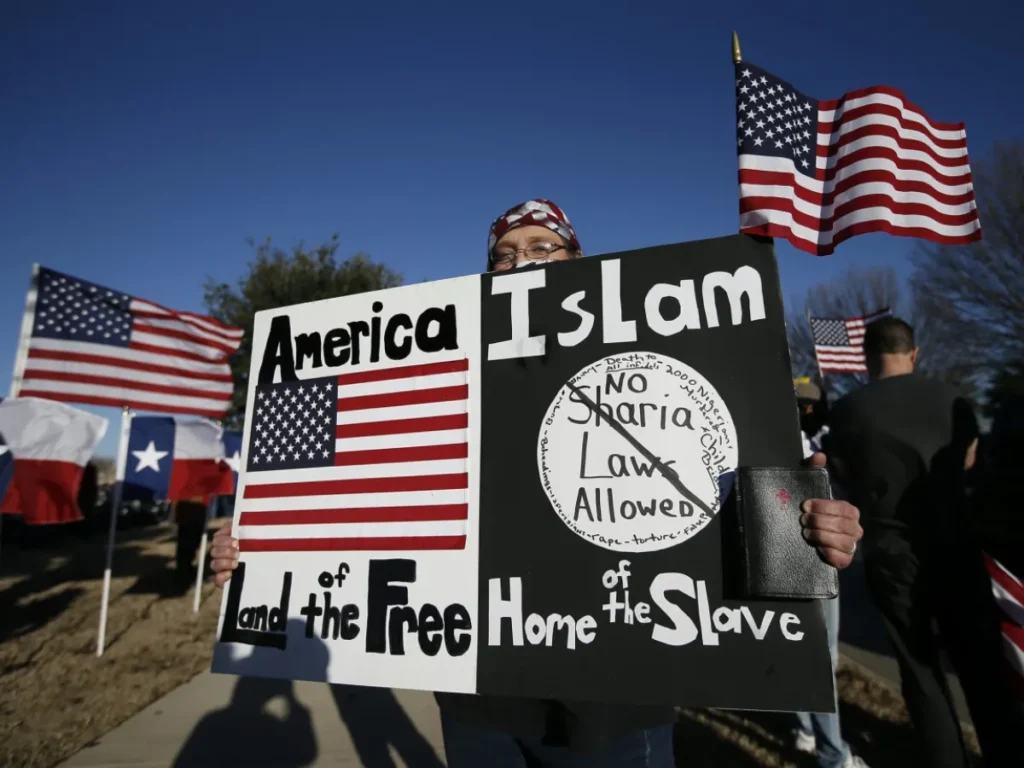
Texas law already prevents religious rules from overriding the Constitution, state statutes or the rights of people who never agreed to follow them. The staying power of the issue comes from something larger: “Sharia” has become shorthand for fears about immigration, Islam, cultural change and who belongs.
Texas politicians regularly warn that Sharia law must be stopped.
The warning creates an obvious impression: an Islamic legal system is attempting to replace Texas law, establish parallel courts and impose religious rules on people who never consented to them.
The actual legal picture is much less dramatic.
Texas courts remain fully in control of which contracts, arbitration agreements and foreign judgments they will recognize. An Islamic agreement cannot override the United States Constitution, the Texas Family Code, due process, domestic-violence protections or the best interests of a child.
The same is true of agreements rooted in Christianity, Judaism or any other religion. So why does Sharia remain such a powerful political issue? Because the argument is no longer mainly about what happens inside a courtroom. It has become an argument about immigration, cultural change, national identity, religious trust and who is considered fully compatible with American life.
The legal question is narrow.
The political usefulness is enormous.
Part of the term’s political power comes from its ambiguity; “Sharia” can refer broadly to Islamic moral and religious guidance. For many Muslims, that includes prayer, fasting, dietary rules, charitable obligations, marriage practices and personal conduct. It can also refer to interpretations of Islamic family law, private contracts or voluntary religious mediation. In some countries, governments incorporate interpretations of Islamic law into their civil or criminal codes. Those are very different things, but political rhetoric often treats them as interchangeable.
A Muslim observing halal dietary rules is not establishing a rival legal system. A couple signing an Islamic marriage agreement is not necessarily rejecting state law. A private religious panel helping willing participants resolve a dispute is not the same as a government court exercising compulsory authority. The legal issue begins when someone asks a civil court to enforce the result.
At that point, Texas law—not religious doctrine—controls; religious rules do not possess independent governmental authority in Texas. An Islamic arbitration panel cannot issue criminal sentences, compel participation by people who never agreed to it or remove a dispute from the jurisdiction of state courts merely by invoking religion.
Its decisions receive legal force only through ordinary contract and arbitration law. That is the same basic framework used for Jewish Beth Din proceedings, Christian conciliation services and secular private arbitration. A court may enforce an agreement when the parties entered it voluntarily, the terms are sufficiently clear and the result does not violate state law or public policy. A court may reject it when there is fraud, coercion, lack of informed consent, procedural unfairness or conflict with protected rights.
One describes this as the application of “neutral principles of law”: courts evaluate the secular legal features of a religious agreement without deciding which religious interpretation is correct.
That distinction matters. Texas courts are not enforcing Sharia as a competing body of sovereign law. They are deciding whether a private agreement happens to satisfy Texas legal standards.
The legitimate concerns are real—but limited
There are genuine reasons for state courts to scrutinize religious contracts and arbitration. A person may be pressured into signing an agreement they do not understand. A private group may exaggerate its legal authority. A religious arbitration clause may be used to disadvantage a spouse with less power or fewer resources. A custody arrangement may conflict with the state’s obligation to protect a child. An agreement may fail to account for domestic violence, abuse or due process. Those concerns should not be dismissed merely because the agreement is religious.
But they are not unique to Islam. Coercion can occur in secular contracts. Unfairness can occur in commercial arbitration. Religious pressure can exist in Christian, Jewish, Muslim or other communities. The state’s responsibility is therefore not to declare one religion uniquely incompatible with law. It is to apply the same standards to everyone.
No contract should be enforced merely because it is religious.
No contract should be rejected merely because it is religious.
What Texas courts actually do
Texas family-law cases provide some of the clearest examples.
A Muslim marriage agreement may include a mahr, a required gift or financial obligation from the groom to the bride. When a dispute reaches a Texas court, the judge does not decide whether the mahr is theologically required.
The court asks ordinary legal questions.
- Was the agreement signed at the proper time?
- Were the terms definite?
- Did both parties understand them?
- Was there adequate financial disclosure?
- Was the agreement voluntary?
- Would enforcement violate state law or public policy?
In Ahmed v. Ahmed, a Texas case involving a $50,000 deferred mahr. The appellate court did not reject the agreement because it was Islamic. It found that the document did not qualify as a premarital agreement because it was signed after the couple had already entered a civil marriage and did not satisfy the requirements for a valid postmarital property agreement. The religious origin of the contract neither protected it from scrutiny nor automatically doomed it, Texas contract law decided the outcome.
The 2022 Texas Supreme Court case In re Ayad provides an even clearer example.
A Muslim couple had signed an agreement requiring marital disputes to be resolved according to Islamic law by a Muslim court or religious panel.
When the marriage broke down, the husband sought to enforce the arbitration clause. The wife argued that she had been misled into signing it, that its terms were indefinite and that enforcement could threaten her constitutional rights and the legal protections governing divorce and child custody.
The trial court ordered arbitration first and planned to review the result afterward.
The Texas Supreme Court intervened.
It held that the trial court had to determine whether the arbitration agreement was valid and enforceable before requiring the wife to participate. In family-law cases, particularly those involving children, the civil court cannot postpone its responsibility to examine coercion, public policy and the best interests of the child.
The decision did not declare Islamic arbitration illegal. It established that religious liberty does not eliminate the court’s duty to protect vulnerable parties before arbitration begins.
That is the actual legal balance: Religious arbitration may be permitted. State authority remains final.
Why, then, is Sharia treated as an approaching threat?
Because “Sharia” can compress several complicated fears into one politically effective word.
It can evoke terrorism, immigration, demographic change, religious conservatism, foreign influence and distrust of Muslim communities at the same time.
A politician does not have to explain the difference between private arbitration and sovereign law.
“Stop Sharia” is simpler.
It identifies a threat, creates a sense of urgency and offers a promise of protection.
The message is powerful even when no one can point to a Texas court surrendering its authority to an Islamic government.
The political argument does not require proof that Sharia is replacing Texas law.
It requires only the fear that it might.
The sovereignty message is hard to oppose; “American laws for American courts” is an effective political slogan because almost everyone agrees with it. Texas courts should apply the United States Constitution, federal law and Texas law. The problem arises when that uncontested principle is used to imply that courts are otherwise in danger of submitting to Islamic authority.
Early attempts in other states to prohibit Sharia explicitly encountered constitutional challenges because they singled out one religion for official condemnation. Advocates responded by replacing explicit references to Sharia with broader restrictions on “foreign law,” allowing similar policy goals to be presented in facially neutral language.
Texas adopted that approach in family law through House Bill 45 in 2017.
The law prevents courts from recognizing foreign judgments or arbitration outcomes that deny constitutional rights, ignore domestic violence or fail to protect a child’s best interests.
Those are reasonable safeguards.
But they also raise a fair question: If courts already possessed the authority to reject agreements that violated constitutional rights or public policy, how much new legal protection did the legislation create?
Symbolic laws still have political value; a law does not have to change many court outcomes to be politically useful.
It can reassure voters. It can signal loyalty to a political coalition. It can force opponents into a difficult rhetorical position. A legislator who supports an anti-Sharia measure can say they are defending the Constitution. A critic who responds that the measure is unnecessary may be portrayed as insufficiently concerned about the threat. A civil-liberties advocate defending equal treatment of Muslims may be accused of defending Sharia itself.
That is the trap. The debate is framed so that defending religious neutrality can sound like defending a foreign legal system. Meanwhile, the underlying legal reality—that no religion can override Texas law—receives less attention than the symbolic conflict.
From courtroom policy to identity politics
The scope of the rhetoric also shows that the issue is no longer confined to contract law.
The Texas Republican platform has language that characterizes Sharia as an incompatible and subversive system and calls for consequences extending beyond the enforcement of private agreements. It reaches questions of public employment, education, taxpayer funding and political loyalty.
Once the discussion moves into those areas, the issue is not simply whether a judge should enforce a religious arbitration clause.
It becomes a broader test:
Can a practicing Muslim be trusted as a public servant?
Is Islamic religious advocacy itself evidence of disloyalty?
Should ordinary Muslim institutions be viewed as civic organizations or potential instruments of subversion?
That is why the debate becomes so emotionally intense.
The phrase “Sharia law” may begin as a legal concern, but it often ends as an argument over whether Muslims can fully belong while remaining visibly Muslim.
EPIC City illustrates the shift
The controversy surrounding the proposed EPIC City development near Dallas demonstrates how quickly the issue can move beyond courts. The project was described as a residential development centered around a Muslim community, including homes, a mosque, a school and commercial space. Opponents warned that it could become a “Sharia city” or autonomous enclave operating outside American law.
The developers denied that characterization. The core legal questions surrounding such a project are ordinary ones:
- Does it comply with land-use rules?
- Does it discriminate unlawfully?
- Are sales and marketing practices truthful?
- Are residents subject to valid municipal, county, state and federal law?
Those are legitimate subjects for investigation.
But calling a Muslim-centered development a “Sharia city” introduces a much larger fear: that cultural concentration itself is evidence of separatism.
Religious and ethnic communities have formed neighborhoods, schools, houses of worship and social institutions throughout American history.
The state should intervene when laws are violated.
It should not assume that a community becomes an alternative government merely because its residents share a faith.
The same distinction applies to Islamic arbitration panels.
The state has every right to investigate a group that falsely claims governmental authority, misleads participants or attempts to operate outside the law.
No private organization should be allowed to present itself as an official court when it is not one.
But a voluntary religious arbitration service is not inherently unlawful.
Private dispute resolution is deeply embedded in American law. Businesses use arbitration. Churches use conciliation. Jewish communities use Beth Din panels. Muslim communities may use faith-based mediators under the same legal limitations.
The relevant questions are neutral:
- Did the parties consent?
- Was the process fair?
- Did the panel remain within its private role?
- Does the outcome violate the law?
The legal mechanics of arbitration are complicated and unexciting. The politics of cultural displacement are simple and powerful.
A courtroom explanation requires distinctions: personal faith versus government power; voluntary agreements versus coercion; religious mediation versus official jurisdiction; constitutional neutrality versus endorsement.
Political messaging rewards the opposite. It rewards collapsing those distinctions into a single conflict between American law and Sharia. That framing offers clarity at the cost of accuracy.
It also responds to a real emotional concern among some voters: the fear that rapid demographic and cultural change will eventually weaken institutions they consider fundamentally American.
Texas should maintain one civil legal system. No religious court should possess sovereign authority. No private agreement should override constitutional rights. No arbitration clause should shield abuse, defeat due process or remove a child from the protection of the state. No organization should misrepresent itself as having governmental jurisdiction.
Those rules should be enforced firmly.
They should also be enforced neutrally.
The same state that prevents a religious agreement from overriding civil law must protect citizens from being excluded or stigmatized because of their religion.
Religious liberty does not mean that every religious contract must be enforced.
It means that Islam should be judged by the same civil standards applied to Christianity, Judaism and every other faith.
Texas is not on the verge of replacing its courts with an Islamic legal system. State judges already decide which agreements are valid. The Constitution already limits government endorsement and hostility toward religion. Family courts already possess authority to protect children, reject coercive agreements and refuse outcomes contrary to public policy.
The real debate is therefore not whether Texas will preserve the supremacy of civil law. It will. The deeper debate is whether political leaders will distinguish between preventing coercion and treating Islamic religious practice itself as evidence of danger.
“Sharia” remains a powerful talking point because it turns a complex argument about law, religion and pluralism into a simple political signal.
It tells some voters that their culture is being defended. It tells others that their loyalty is permanently in question.
Texas should reject any attempt by any religion to exercise governmental power.
It should also reject the idea that ordinary religious observance constitutes a rival government.
The legal boundary is already clear: Religious freedom protects voluntary belief and private practice. Texas law remains supreme.
The legal threat is limited. The political value of invoking it is not.